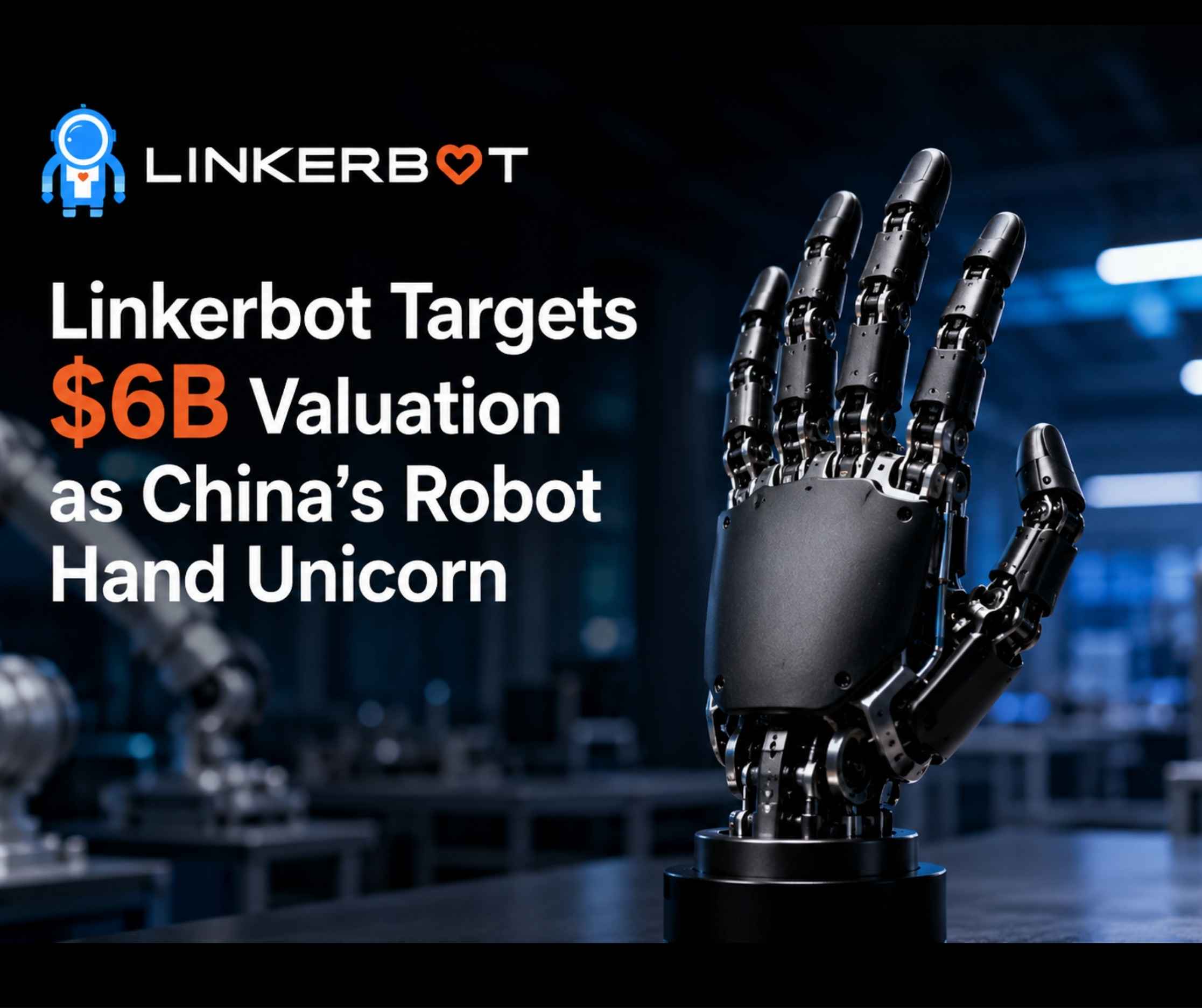
Beijing-based robotics startup Linkerbot is preparing to raise its next funding round at a $6 billion valuation, just days after closing a Series B+ at $3 billion. The two-year-old company makes dexterous robot hands and has quietly become the dominant global supplier in a category most investors had written off as a research problem rather than a business.
The company currently holds more than 80 percent of the global market for high-degree-of-freedom dexterous robot hands by volume and is the only operation in the world capable of shipping above 1,000 units a month. Production is on track to scale from roughly 5,000 units monthly to 10,000.
From a Cartoon Cat to a Billion-Dollar Robotics Company
The origin story is unconventional. CEO Alex Zhou Yong told the South China Morning Post that the idea traces back to Doraemon, the Japanese animated cat famous for pulling gadgets from a magical pocket. Zhou, who studied robotics, eventually concluded the real trick was not the pocket but the hands. A China robotics startup capable of genuine dexterous manipulation does not need a specialised tool for every task. It can use the tools humans already have.
Founded in 2023, Linkerbot built its flagship Linker Hand series to span six to 42 degrees of freedom, covering the full range of actuation methods used across the field. The lightweight O6 model weighs just 370 grams and is rated to handle a 50kg load. Higher degree-of-freedom variants such as the L30 are aimed at research institutions and humanoid robot integrators that require finer-grained control.
In demonstrations, the dexterous robot hands turn screws at speed, grasp soft objects without crushing them, thread a needle, and carry out precision assembly tasks. The distinction Linkerbot draws is not novelty but scale. These capabilities are now being delivered on a production line, not inside a lab.
Humanoid Robot Investment Flows Into China’s Fastest-Growing Robotics Startup
Early backers include Ant Group, the financial services arm of Alibaba, and HongShan Group, the Chinese spin-out of Sequoia Capital. The latest round added the state-backed Zhongguancun Science Park Fund, Bank of China Asset Management, and Fosun Capital. The combination of private internet capital, state vehicles, and a major bank reflects where humanoid robot investment in China is concentrated in 2026.
The funding comes against a backdrop of surging interest in Chinese humanoid robotics. A viral Beijing humanoid robot half-marathon in April, where a Tien Kung Ultra unit finished seven minutes ahead of the human world record, brought mainstream attention to the sector. Unitree filed for a Shanghai listing in March targeting a valuation of around $7 billion. Rival China deep tech unicorn contenders including Galbot, AgiBot, and AI2 Robotics are clustered in the $2 billion to $3 billion range.
Hands That Build Hands
The most quietly ambitious detail in Linkerbot’s expansion plan is that some of its five factories across Beijing and Shenzhen are being designed as intelligent production lines where dexterous robot hands assemble more dexterous robot hands. If that model proves out, it would represent one of the first commercial demonstrations of dexterous manipulation moving from research into closed-loop manufacturing at scale.
Linkerbot also claims to have built LinkerSkillNet, described as the largest real-world dataset of dexterous manipulation skills in operation, with more than 500 captured behaviours. Proprietary training data accumulated at production scale will shape next-generation manipulation models in ways competitors without volume cannot replicate.
The $6 Billion Question
Whether the Linkerbot valuation holds will depend on which market thesis plays out. If humanoid robots remain industrial niche products, Linkerbot’s role as a component supplier limits its ceiling regardless of market share. If the sector follows the trajectory many humanoid robot investors now assume, with humanoids moving into logistics, services, and eventually domestic environments, a volume supplier with deep manufacturing capability and a proprietary data stack could capture a disproportionate share of value across the entire chain.
Risks are real. Geopolitical exposure from state-fund investors and a Beijing-Shenzhen footprint draws scrutiny at a moment of renewed US attention on Chinese deep tech. Tesla has signalled it intends to integrate hand designs in-house for its Optimus program. Platform players including Meta, following its acquisition of Assured Robot Intelligence, appear to want the whole robot rather than a third-party bill of materials.
Linkerbot’s answer is simple: be the only China robotics startup shipping at volume before anyone else gets there. With more than 400 employees, five factories, and a customer base that cannot yet source comparable supply anywhere else, this China deep tech unicorn contender is racing to make that lead insurmountable.
Discover the startups reshaping Asia’s tech landscape. Explore more at BestStartup.Asia