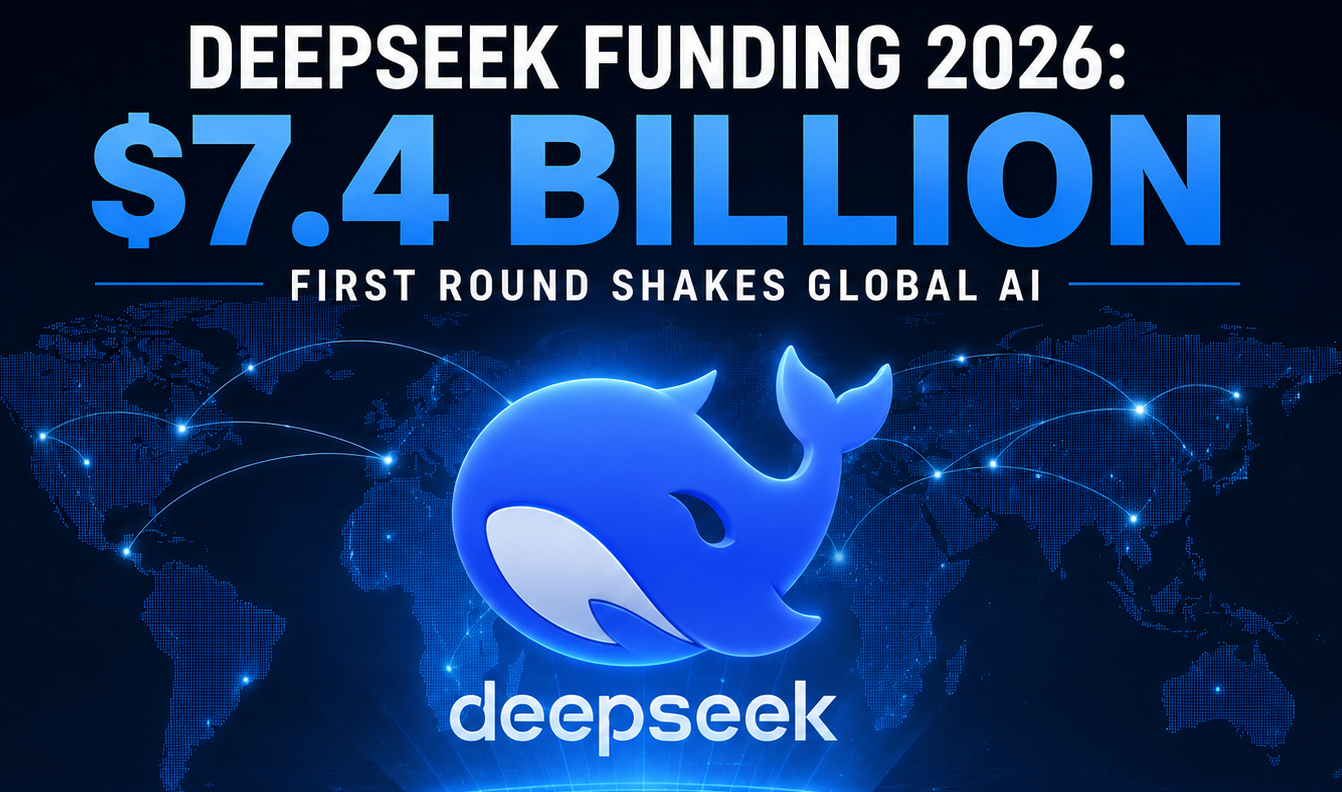
DeepSeek funding 2026 marks the end of DeepSeek’s era as a purely self-funded research lab. The Hangzhou-based AI company has raised $7.4 billion in its first-ever external funding round, achieving a post-money valuation of over $50 billion. The round was led by Tencent and CATL, China’s dominant battery manufacturer, and co-invested by China’s National AI Industry Investment Fund.
This investment vaults DeepSeek to the top of China’s AI startup rankings and positions it among the most important AI companies on the planet. Asia’s AI chip race is heating up across the region, with Nvidia and AMD committing billions to Taiwan’s AI chip ecosystem. DeepSeek’s models have repeatedly shocked the global AI industry with their performance-to-cost ratio. China is pushing boundaries on multiple AI fronts, including the world’s first commercial brain-computer interface. The $7.4 billion capital infusion signals Beijing’s determination to ensure that advantage is sustained and scaled. The funding structure with commercial investors locked up for five years with no voting rights and the state fund holding direct equity and voting rights reveals as much about China’s AI strategy as the headline number itself.
Table of Contents
- What Is DeepSeek
- DeepSeek Funding 2026: The $7.4 Billion Round Explained
- Who Invested: Tencent, CATL, and China’s National AI Fund
- The Unusual Investment Structure: Lock-Up and Voting Rights
- Why DeepSeek’s First External Funding Matters for Asia
- What This Means for Asia’s AI Ecosystem
- Key Takeaways
- FAQ: DeepSeek Funding 2026
What Is DeepSeek
DeepSeek is a Chinese AI research laboratory headquartered in Hangzhou, Zhejiang Province, China. It was founded by Liang Wenfeng, the co-founder of quantitative hedge fund High-Flyer. Unlike most frontier AI labs, DeepSeek was self-funded from inception, operating with no external investors or commercial obligations until this round. That independence gave it the freedom to pursue research directions that commercially-driven Western AI labs deprioritised.
DeepSeek gained global attention in early 2025 when it released models that matched or exceeded the performance of leading US AI models at a fraction of the training cost. DeepSeek’s R1 reasoning model and V3 language model demonstrated that frontier AI capabilities were achievable without the multi-billion dollar training compute budgets that US AI labs had treated as a prerequisite. The releases triggered a significant reassessment of AI compute requirements across the global industry and caused a notable selloff in AI infrastructure stocks.
DeepSeek Funding 2026: The $7.4 Billion Round Explained
The DeepSeek funding 2026 round raised $7.4 billion, equivalent to approximately 50 billion yuan, at a valuation exceeding $50 billion. This is DeepSeek’s first external funding in its history, marking a fundamental shift from its self-funded research lab model to a capitalised AI company with institutional investors and state backing.
The sheer size of the round tells you two things at once. DeepSeek has earned Beijing’s full strategic backing, and its models have built enough real-world credibility to attract serious commercial capital. A $7.4 billion first raise at a $50 billion valuation implies that investors are pricing DeepSeek as a category-defining AI infrastructure company rather than simply a research lab with impressive papers.
The funds will be used to scale DeepSeek’s compute infrastructure, expand its research team, and accelerate the commercialisation of its models across enterprise and government clients in China and internationally across Asia. DeepSeek has been notably restrained in its commercial activities to date, prioritising research output over revenue. The external capital positions it to change that balance.
Stay ahead of every major Asia AI funding round, policy development, and startup story as it breaks.
👉 Follow Asia Startup News at BestStartup.Asia
Who Invested: Tencent, CATL, and China’s National AI Fund
The investor lineup in the DeepSeek funding 2026 round is strategically deliberate. Tencent, China’s largest technology conglomerate by market capitalisation, brings distribution across WeChat’s 1.3 billion users and a vast enterprise ecosystem. Tencent’s investment gives DeepSeek a commercial partner capable of deploying its models at a scale that no other Asian company can match.
CATL, the world’s largest battery manufacturer and a core component of China’s technology industrial complex, is a less obvious but equally significant investor. CATL’s investment signals that DeepSeek’s AI capabilities have applications beyond software, potentially including autonomous vehicle intelligence, industrial automation, and energy grid management. CATL operates at the intersection of hardware and software at a scale where AI optimisation delivers measurable efficiency gains worth billions of dollars annually.
China’s National AI Industry Investment Fund rounds out the syndicate, providing state backing that signals Beijing’s endorsement of DeepSeek as a national AI champion. The fund’s participation is not purely financial. It is a signal to the rest of China’s technology industry that DeepSeek has the full support and protection of the Chinese state in its competition with US and European AI companies.
The Unusual Investment Structure: Lock-Up and Voting Rights
Here is the thing. The structure of the DeepSeek funding 2026 round is as noteworthy as the amount raised. Commercial investors Tencent, CATL, and others, are subject to a five-year lock-up period and hold no voting rights. China’s National AI Industry Investment Fund holds direct equity with voting rights and no lock-up restriction.
This structure concentrates governance control with the state while distributing financial exposure to commercial partners. It means that DeepSeek’s strategic direction cannot be influenced by commercial investors seeking near-term returns or exits. The company’s research priorities, international expansion decisions, and technology sharing arrangements are effectively insulated from commercial pressure for the duration of the lock-up.
But wait. For global AI observers and Asian enterprises evaluating DeepSeek, this structure raises significant questions about long-term independence. A company where the state fund holds the only voting rights is not an independent research lab in any meaningful governance sense. It is a state-aligned AI research organisation with commercial investors as minority financial partners. That distinction matters for enterprises across Southeast Asia, Japan, South Korea, and India currently evaluating whether to deploy DeepSeek models in their infrastructure.
Why DeepSeek’s First External Funding Matters for Asia
The DeepSeek funding 2026 round matters across Asia for three clear reasons. First, it confirms that DeepSeek is building for the long term. A $7.4 billion raise is not a defensive move. It is an offensive capital deployment designed to close the compute gap with OpenAI, Anthropic, and Google DeepMind, and to expand DeepSeek’s commercial reach across Asian markets.
Second, it changes the AI competitive dynamics for every Asian AI company. DeepSeek’s models were already competitive at a fraction of the cost. With $7.4 billion in new capital, DeepSeek can train even larger and more capable models, potentially disrupting the pricing and performance benchmarks that US AI companies have established as the commercial standard across the region.
Third, it creates a template for how state-backed AI investments can be structured to maintain governance control while attracting commercial capital. China’s model of using the National AI Fund as a voting rights holder while commercial investors provide the bulk of the capital is likely to be replicated across other Chinese AI national champions and observed closely by governments across Southeast Asia seeking to develop their own sovereign AI strategies.
What This Means for Asia’s AI Ecosystem
For Asian AI founders and investors outside China, the DeepSeek funding 2026 round carries both a warning and an opportunity. The warning is straightforward: DeepSeek’s combination of frontier model capabilities and state-backed capital creates a formidable competitor for any AI company targeting enterprise customers across the Asia-Pacific region.
The opportunity is equally clear. DeepSeek’s governance structure, state voting rights, commercial investor lock-up, makes it a non-starter for many regulated enterprise and government markets across Asia that are wary of Chinese state-influenced technology. Enterprises in Japan, South Korea, Singapore, India, and Southeast Asia that want frontier AI capabilities without geopolitical risk are actively seeking alternatives. Asian AI companies built under transparent, commercially-governed structures are well-positioned to capture that demand.
The DeepSeek round also validates the scale of investment required to compete at the frontier of AI development. Asian sovereign wealth funds, development banks, and national AI strategies across the region now have a clear benchmark: $7.4 billion is the entry price for a credible frontier AI programme. That benchmark will accelerate AI investment decisions across Singapore, Japan, South Korea, and the UAE in 2026 and beyond.
Asia’s AI startup ecosystem is moving fast. Stay ahead of every deal, funding round, and policy shift that matters.
👉 Explore Asia’s Top AI Startups at BestStartup.Asia
Key Takeaways
DeepSeek has raised $7.4 billion in its first-ever external funding round at a post-money valuation of over $50 billion, making it China’s most valuable AI startup. Investors include Tencent, CATL, and China’s National AI Industry Investment Fund. Commercial investors are subject to a five-year lock-up with no voting rights. The state fund holds voting rights with no lock-up, giving the Chinese government effective governance control. The capital will fund compute infrastructure expansion, research team growth, and enterprise commercialisation across China and Asia. The funding structure creates a governance risk that opens significant market opportunity for Asian AI companies built under transparent commercial governance.
FAQ: DeepSeek Funding 2026
How much did DeepSeek raise in 2026?
DeepSeek raised exactly $7.4 billion (approximately 50 billion yuan) in its first-ever external funding round. The post-money valuation exceeds $50 billion, confirmed in 2026.
Who invested in DeepSeek’s 2026 funding round?
Tencent and CATL led the round alongside China’s National AI Industry Investment Fund. Commercial investors hold no voting rights and face a five-year lock-up, while the state fund holds voting rights with no lock-up.
What is DeepSeek’s valuation after the 2026 funding round?
DeepSeek’s post-money valuation exceeds $50 billion following the $7.4 billion first funding round, making it China’s most valuable AI startup.
Is DeepSeek state-controlled after the funding round?
China’s National AI Fund holds voting rights in DeepSeek with no lock-up restriction. Commercial investors (Tencent, CATL) hold no voting rights and are locked up for five years, giving the Chinese state effective governance control over DeepSeek’s strategic direction.
What will DeepSeek use the $7.4 billion for?
DeepSeek will scale compute infrastructure, expand its research team, and accelerate commercialisation of its AI models for enterprise and government clients across China and Asian markets.
Why does the DeepSeek funding round matter for Asia?
The round confirms DeepSeek as a long-term frontier AI competitor with state backing, raising the competitive bar across Asia. Its governance structure (state voting rights) creates a market opportunity for non-Chinese Asian AI companies targeting enterprises that want frontier AI capabilities without geopolitical risk.