
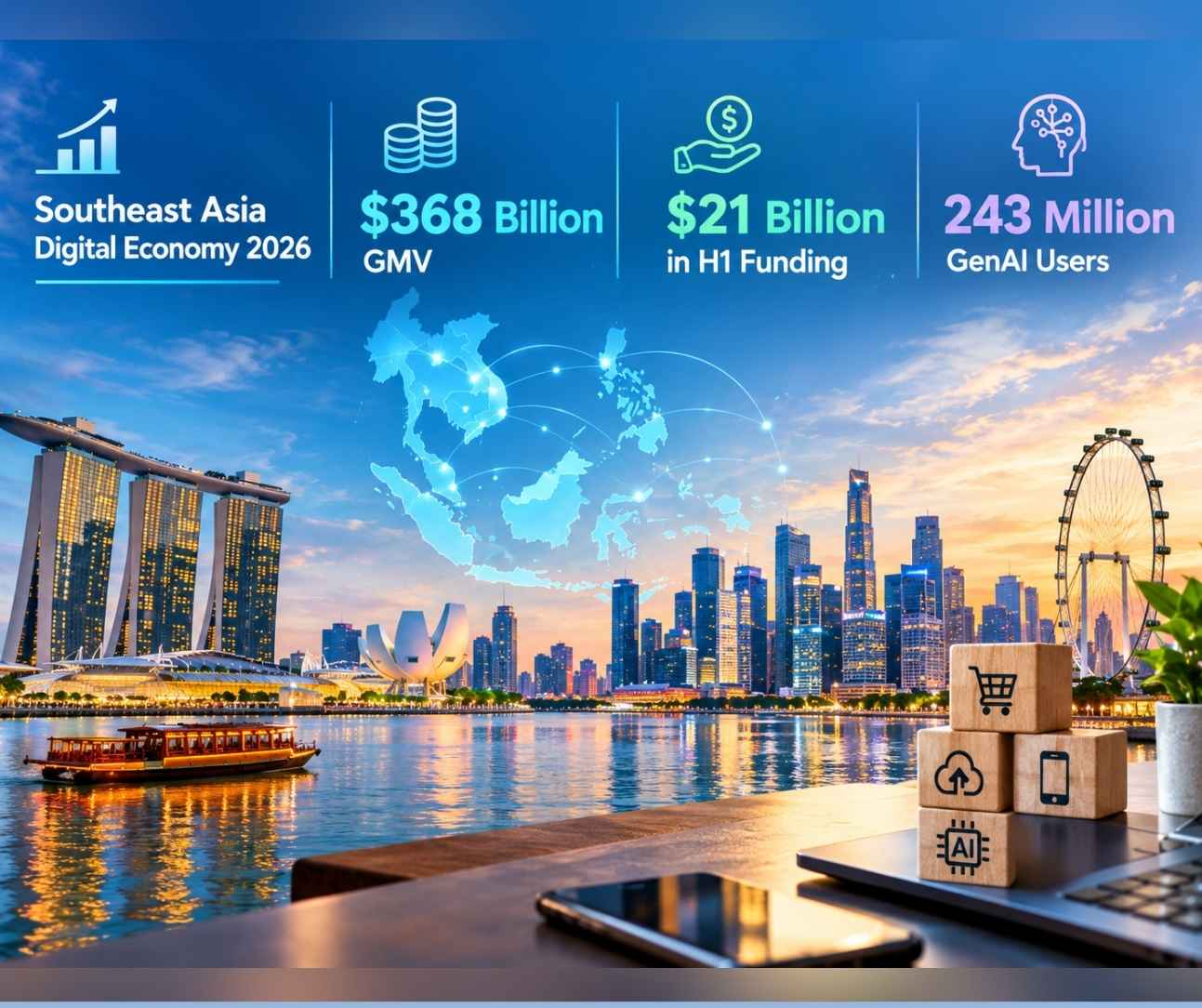
Southeast Asia’s digital economy is on track to reach $368 billion in gross merchandise value (GMV) in 2026 — a 17% year-on-year increase — and is projected to exceed $1.14 trillion by 2035, according to the e-Conomy SEA 2026 report published by Google, Temasek and Bain & Company on 21 October 2026. Business Times reports the 17% rise was driven by AI-led infrastructure investment and rapid GenAI adoption across the region.
The report, titled Building the Intelligent Economy, tracks Southeast Asia’s digital economy across six countries: Indonesia, Malaysia, Philippines, Singapore, Thailand and Vietnam. It is now in its 11th annual edition.
Private funding surged to $21 billion in H1 2026 alone — nearly double the $11 billion recorded for all of 2025 — driven by two landmark data center deals. AI-related companies captured 80% of deal value in the past six months, up from 30% in H2 2024.
Southeast Asia Digital Economy 2026: Key Data at a Glance
| Metric | Figure |
|---|---|
| 2026 GMV forecast | $368 billion (+17% YoY) |
| 2035 GMV forecast | $1.14 trillion (~13% annual growth) |
| Private funding, H1 2026 | $21 billion |
| Private funding, full-year 2025 | $11 billion |
| Private deals, 2025 | 421 (down 28.4% YoY) |
| Data center capacity, H1 2026 | 5.8 GW (up from 4 GW at end-2025) |
| IPO proceeds (12 months to June 2026) | $8.5 billion (up from $3.6 billion) |
| GenAI adopters | 243 million people (58% of working population) |
| AI tokens per capita (SEA) | 5 to 7 million (US: 60 million; Europe: 14 million) |
| Projected AI usage growth by 2030 | Up to 60x current levels |
Source: e-Conomy SEA 2026 report, Google, Temasek, Bain & Company (21 October 2026)
What Is the e-Conomy SEA Report?
The e-Conomy SEA report is an annual study of Southeast Asia’s digital economy produced jointly by Google, Temasek and Bain & Company. First published in 2016, it tracks GMV, private funding, IPO activity and digital adoption across Indonesia, Malaysia, Philippines, Singapore, Thailand and Vietnam. The 2026 edition is the 11th in the series and the first to use AI token consumption as a primary metric for measuring AI adoption depth.
Record Data Center Investment Powers Southeast Asia’s AI Decade
Two data center transactions dominated private funding in H1 2026. STT GDC, a Singapore-headquartered data center operator, closed an $11 billion deal. DayOne, another regional data center platform, completed a $5 billion transaction. Together these two deals alone account for $16 billion of the $21 billion total.
Built data center capacity across the region reached 5.8 gigawatts by mid-2026, up from 4 gigawatts at the end of 2025. The report projects that meeting demand through 2030 will require approximately 3x expansion in data center capacity over the next five years.
Singapore anchors the majority of this infrastructure. The city-state has allocated an additional 200MW of green energy to its 1.4GW compute base and has enacted binding Power Usage Effectiveness (PUE) requirements under its Digital Infrastructure Bill to ensure sustainability at scale.
Malaysia is also emerging as a significant data center hub, with its Corporate Renewable Energy Supply Scheme (CRESS) model enabling cost-competitive clean energy for AI workloads. For more on AI-led startup funding surges across the region, see Manus AI’s $500M round at a $4B valuation — one of the largest AI deals in Asia in October 2026.
Southeast Asia’s Six Digital Sectors: GMV and Growth
The 2026 report tracks growth across six digital verticals. E-commerce leads with $226 billion GMV, up 18% year on year. Thirty-one percent of product searches are now multimodal and 69% of shoppers use AI to compare purchases. AI is driving a 10% conversion lift and up to 75% higher average order value for leading platforms.
Online travel reached $59 billion GMV, up 10%. Standalone GenAI platforms have overtaken social media as the secondary planning tool, capturing 26% of planning journeys versus social media’s 23%.
Online media — digital advertising, streaming and gaming — reached $44 billion revenue, up 22%, making it the fastest-growing sector. Commerce media on e-commerce platforms alone has grown into a $4 billion market.
Mobility and food delivery reached $40 billion GMV, up 15%. AI-driven route optimisation and predictive home-screen suggestions are driving a 28% surge in ride-hailing demand.
Digital financial services reached $1,650 billion gross transaction value (GTV), up 16%. Digital lending balances grew 22% to $116 billion. Singapore leads digital wealth platform adoption with active user penetration nearly triple the next-ranked market in the region.
243 Million Southeast Asians Have Adopted Generative AI
Generative AI adoption across Southeast Asia has reached 243 million people, representing approximately 58% of the working-age population. The report notes this scaling occurred four times faster than mobile internet adoption, achieving this reach in under three years.
Despite this, per-capita usage remains far behind global leaders. Southeast Asians consumed approximately 5 to 7 million AI tokens per capita, compared with 60 million in the United States and 14 million in Europe. Consumers account for roughly 60% of regional tokens, mostly for everyday work and study tasks. Enterprise usage has significant room to grow.
Singapore is the regional outlier. GenAI penetration in Singapore has reached 70% of the working population (3.2 million people), with per capita usage at nearly half the US level and about twice Europe’s level. Enterprise workloads drive 45% to 60% of usage in Singapore and Malaysia, the two most mature markets.
The report projects that AI usage across Southeast Asia could climb up to 60-fold by 2030 as inference costs fall, enterprise workloads scale and agentic AI moves from single-turn queries to multi-step autonomous workflows. Seventy-two percent of users currently rely on everyday automations, and 75% say they are willing to let AI agents autonomously complete purchases on their behalf.
Singapore Widens Its AI Lead in Southeast Asia
Singapore’s digital economy GMV is projected to reach $31 billion in 2026, up 8% year on year, and is on track to reach $59 billion by 2035. The country hosts the majority of Southeast Asia’s AI infrastructure funding and has enacted governance frameworks specifically for agentic AI deployment.
Singapore’s Model AI Governance Framework for Agentic AI and the Safeguards for Agentic Finance at Runtime (SAFR) establish the region’s clearest guidelines for autonomous AI deployment in financial services. Its National AI Impact Programme aims to train 100,000 individuals in AI skills by 2029.
The upcoming ASEAN Digital Economy Framework Agreement (DEFA), expected in November 2026, will establish the world’s first region-wide digital trade pact and is expected to accelerate cross-border e-commerce, data flows and digital financial services across all 10 ASEAN member states. For the latest on Southeast Asia AI startup activity, see our Top 10 Southeast Asia AI Startups to Watch in Q4 2026.
👉 Track Southeast Asia’s Fastest-Growing Startups at BestStartup.Asia
IPO Market Doubles: Capital Markets Strengthen Across the Region
IPO proceeds across Southeast Asia reached $8.5 billion in the 12 months through 30 June 2026 — more than double the $3.6 billion recorded in the previous 12-month period. Singapore and Malaysia drove the majority of listing activity. The strengthening IPO pipeline reflects growing investor confidence in regional digital businesses following years of post-pandemic valuation reset.
Key Takeaways: Southeast Asia Digital Economy 2026
Southeast Asia’s digital GMV reaches $368 billion in 2026, up 17%, and is projected to exceed $1.14 trillion by 2035. Private funding hit $21 billion in H1 2026 alone, nearly double the prior full year, driven by two mega data center deals totalling $16 billion. Data center capacity grew from 4 GW to 5.8 GW in six months. GenAI has been adopted by 243 million people in under three years. AI usage per capita is still only 5 to 7 million tokens versus 60 million in the US. AI-focused companies captured 80% of deal value. IPO proceeds doubled to $8.5 billion. Singapore leads with 70% GenAI penetration. The ASEAN DEFA digital trade pact arrives in November 2026.
Frequently Asked Questions: Southeast Asia Digital Economy 2026
1. What is Southeast Asia’s digital economy GMV in 2026?
Southeast Asia’s digital gross merchandise value is forecast to reach $368 billion in 2026, a 17% increase year on year, according to the e-Conomy SEA 2026 report by Google, Temasek and Bain & Company published on 21 October 2026.
2. When will Southeast Asia’s digital economy reach $1 trillion?
The e-Conomy SEA 2026 report projects Southeast Asia’s digital economy will exceed $1.14 trillion in gross merchandise value by 2035, growing at approximately 13% per year from its 2026 base of $368 billion.
3. How many people in Southeast Asia use generative AI?
243 million people in Southeast Asia have adopted generative AI tools as of October 2026, representing approximately 58% of the working-age population. This adoption scaled four times faster than mobile internet, reaching this level in under three years.
4. What are the two big data center deals that drove Southeast Asia funding in 2026?
The two landmark transactions are the $11 billion acquisition of ST Telemedia Global Data Centres (STT GDC) and a $5 billion deal involving DayOne. Together they account for $16 billion of the $21 billion in private funding recorded across H1 2026.
5. How does Southeast Asia’s AI usage compare to the US and Europe?
Southeast Asians consumed approximately 5 to 7 million AI tokens per capita in 2026, compared with 60 million in the United States and 14 million in Europe. The region’s usage is roughly 10% of US levels despite having the world’s fastest GenAI adoption rate.
6. What is the ASEAN Digital Economy Framework Agreement (DEFA)?
The ASEAN DEFA, expected in November 2026, will be the world’s first region-wide digital trade pact. It will establish a framework governing cross-border e-commerce, data flows and digital financial services across all 10 ASEAN member states.
7. Which country leads Southeast Asia’s AI adoption?
Singapore leads the region with 70% GenAI penetration among its working population (3.2 million people). Per capita AI usage in Singapore is nearly half the US level and approximately twice Europe’s level.
8. What sectors are driving Southeast Asia’s digital economy growth in 2026?
E-commerce leads with $226 billion GMV (+18%), followed by digital financial services at $1,650 billion GTV (+16%), online media at $44 billion revenue (+22%), online travel at $59 billion GMV (+10%), and mobility and food delivery at $40 billion GMV (+15%).
9. How much has Southeast Asia’s data center capacity grown in 2026?
Southeast Asia’s built data center capacity grew from 4 gigawatts at the end of 2025 to 5.8 gigawatts by mid-2026, a 45% increase in six months. The region will need approximately 3x expansion over five years to meet AI workload demand through 2030.
10. What is the e-Conomy SEA 2026 report and who publishes it?
The e-Conomy SEA 2026 report, titled Building the Intelligent Economy, is the 11th annual edition published jointly by Google, Temasek and Bain & Company. Released on 21 October 2026, it covers Indonesia, Malaysia, Philippines, Singapore, Thailand and Vietnam.
Sources: e-Conomy SEA 2026 report, Google, Temasek, Bain & Company (21 October 2026) | Business Times