


The Google AI for the Planet Accelerator has officially launched across Asia Pacific, and it may be the single most important opportunity for climate-tech founders, researchers, and environmental organisations in the region in 2026. If you are building at the intersection of artificial intelligence and sustainability, this programme deserves your full attention.
Table of Contents
- What Is the Google AI for the Planet Accelerator?
- Why Google Is Focusing on Asia Pacific
- What Selected Participants Actually Receive
- The Google for Startups Southeast Asia Accelerator Is Also Open Now
- What Google DeepMind Is Already Doing in Climate Tech
- The Real Challenge: AI Has Its Own Environmental Cost
- Should Your Startup Apply?
- Key Dates and How to Apply
What Is the Google AI for the Planet Accelerator?
The Google AI for the Planet Accelerator is a three-month programme open to startups, research groups, and non-profit organisations across Asia Pacific that are already developing solutions in climate, agriculture, energy, nature conservation, and broader environmental risk management.
This is not an ideation programme. Google is specifically looking for organisations with existing products or projects in development that need world-class AI expertise to scale their impact faster.
Selected participants will receive direct mentorship and technical support from Google AI and Google DeepMind teams. That support includes hands-on integration of advanced AI models and scientific tools into participants’ existing products. The first cohort will begin with an in-person bootcamp in Singapore.
Google is currently collecting expressions of interest. Full eligibility criteria, cohort size, and selection timelines will be confirmed shortly.
Why Google Is Focusing on Asia Pacific for This Climate Initiative
Asia Pacific occupies a unique and urgent position in the global climate conversation. The region is simultaneously one of the world’s fastest-growing economic engines and one of the most exposed to climate-related risk.
Countries across Southeast Asia, South Asia, and the Pacific face escalating threats from extreme weather events, coastal flooding, disruptions to agriculture and food supply chains, and mounting pressure on energy systems. At the same time, the region’s startup ecosystems in Singapore, Jakarta, Bangkok, Kuala Lumpur, and beyond are producing technically capable founding teams with deep domain knowledge in local markets.
Ben King, Google’s Country Managing Director for Singapore and Malaysia, addressed this directly at the Ecosperity conference in Singapore. “The global conversation has shifted fundamentally. It is no longer about where AI can scale. It is more about how we can intentionally use this technology to solve some of the most urgent challenges that we have, including climate change,” he said.
Google recognises that environmental technologies in Asia Pacific are advancing but are not scaling quickly enough to match rising climate risks. The Google AI for the Planet Accelerator is designed to close that gap.
What Selected Participants in the Google AI for the Planet Accelerator Actually Receive
Participation in the Google AI for the Planet Accelerator comes with a level of technical support that most organisations in the climate space cannot access independently.
Selected participants receive dedicated mentorship from Google AI experts. They work directly with Google DeepMind researchers and engineers on integrating scientific models into their existing products. They gain access to Google’s broader technical infrastructure and benefit from the connections and credibility that come with being part of a Google-backed programme.
Unlike standard accelerator programmes that focus primarily on fundraising and pitch coaching, this initiative is built around deep technical collaboration. The goal is to help participants do something harder and more valuable: make their AI-powered climate solutions genuinely work at scale in the real world.
The Google for Startups Southeast Asia Accelerator Is Also Open Right Now
Running alongside the AI for the Planet initiative, Google for Startups has opened applications for its flagship Google for Startups Accelerator: Southeast Asia programme. Applications close on June 20, 2026.
This programme is entirely equity-free and accepts startups from Seed to Series B stage. It is one of the most resource-rich accelerator programmes available to founders in Southeast Asia today.
Selected startups receive direct engineering support from Google teams across Cloud, Android, Play, Ads, and AI/ML divisions. They gain early access to Google’s latest AI products through Trusted Tester and Early Access Programme benefits. Free Cloud TPU access is provided to accelerate machine learning research and model development. Google Cloud credits are available to power infrastructure at scale. Founders and technical leads receive one-on-one mentoring from Google engineers and senior industry experts. The programme includes an intensive in-person bootcamp in San Francisco or Singapore. Strategic support covers company building, product design, and customer acquisition.
To apply, visit the official programme page at https://startup.google.com/programs/accelerator/southeast-asia/
What Google DeepMind Is Already Doing in Climate Technology
The Google AI for the Planet Accelerator is not built on promises. Google and DeepMind already have a track record of real-world climate AI deployments that demonstrate what becomes possible when frontier AI meets environmental challenges.
DeepMind’s predictive models for wind and solar generation are helping energy grid operators forecast renewable output with significantly higher accuracy. This is a critical capability for operators working to phase out fossil fuel backup systems and build more reliable clean energy infrastructure.
Project Greenlight, Google’s traffic optimisation initiative, is reducing vehicle idling at urban intersections across multiple cities. The result is measurable reductions in localised emissions in dense urban environments where air pollution disproportionately affects lower-income communities.
Google’s agricultural mapping tools are helping farmers in developing markets make better decisions about planting schedules, irrigation, and pest management. In regions where climate volatility is already disrupting harvests, this kind of decision support can directly protect food security.
“We see it in unlocking immense real-world opportunities in areas like carbon mitigation, energy transformation, and climate adaptation,” King said. “We are seeing this work take shape today. It is not just a forward view. It is happening in real time.”
The Real Challenge: AI Has Its Own Environmental Cost
Honest coverage of the Google AI for the Planet Accelerator requires acknowledging the tension that sits at its centre.
The International Energy Agency projects that global electricity consumption from data centres will more than double by 2030, reaching approximately 945 terawatt-hours. That growth is driven overwhelmingly by the expansion of AI infrastructure. Southeast Asia is expected to see significant growth in data centre energy demand as governments and companies continue scaling digital infrastructure across the region.
Every AI model trained, every query processed, every automated output generated consumes electricity. A meaningful share of that electricity still comes from fossil fuel sources.
Google, Microsoft, Amazon, and other major technology companies are investing in renewable energy procurement and next-generation grid solutions. But researchers and policymakers continue to debate whether AI’s growing energy requirements could offset some of the emissions reductions that the technology enables elsewhere in the economy.
King acknowledged the concern. “We see the benefits can outweigh the risks.” The climate science community broadly agrees that the outcomes will depend heavily on the decisions the industry makes over the next five years, particularly around energy sourcing and hardware efficiency.
What is not seriously in dispute is that applications like renewable energy forecasting, agricultural optimisation, and climate adaptation planning represent some of the highest-value use cases for AI in the world today. If the Google AI for the Planet Accelerator helps scale even a handful of those solutions across Asia Pacific, the impact would be substantial.
Should Your Startup Apply for the Google AI for the Planet Accelerator?
If you are building in climate, energy, agriculture, nature conservation, or environmental risk management and you are based in Asia Pacific, the answer is yes.
The Google AI for the Planet Accelerator offers something rare: direct access to Google DeepMind expertise for organisations working on problems that genuinely matter. For most startups and research groups in the climate space, that level of technical partnership is simply not available elsewhere at any price.
For Southeast Asia-based startups at Seed to Series B stage, the Google for Startups Accelerator running in parallel is equally compelling. The equity-free structure, Cloud credits, TPU access, and direct engineering support from Google teams make it one of the strongest accelerator offerings in the region.
Key Dates and How to Apply for the Google for Startups Southeast Asia Accelerator
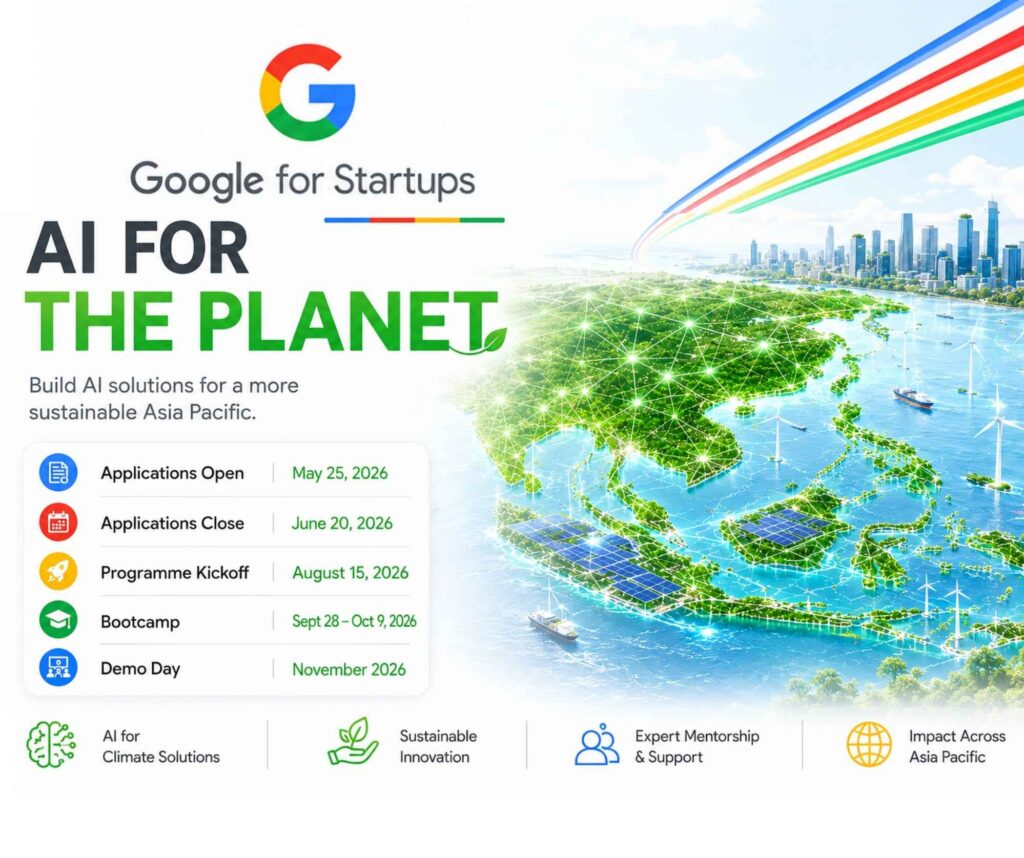
Applications Open: May 25, 2026 Applications Close: June 20, 2026 Programme Kickoff: August 15, 2026 Bootcamp: September 28 to October 9, 2026 Graduation and Demo Day: November 2026
Apply now at https://startup.google.com/programs/accelerator/southeast-asia/
For the AI for the Planet programme, Google is collecting expressions of interest now at https://startup.google.com/
Get your startup featured on BestStartup.Asia and reach founders, investors, innovators, and global tech readers across Asia Pacific.